
LIVE VIRTUAL TRAINING · 2 HR
July 30, 2026 / Time: 7:30 - 9:30pm EST
Traumatizing,
Triggering &
Trapping
How to identify and course-correct when conventional FBAs and behavior plans are hurting more than helping
Rick & Doris Bowman
Bowman Consulting Group
PROMOTED IN PARTNERSHIP WITH
KAREN MAYER CUNNINGHAM
& THE SPECIAL EDUCATION ACADEMY
Attending Karen's webinar? Use her referral code for 40% off

THE PROBLEM
You pull out the behavior plan. You read the goals. You know this child — their history, their patterns, their hard days.
And still, nothing changes. The question that haunts you: Why isn't this working?
For decades, educators have been handed tools built on a simple belief: if a child knows the rules and still doesn't follow them, the problem is motivation, choice, or character. So we:
Write plans that apply consequences
Track behavior on charts
Create reward systems
Wait for the child to show improvement
But today's children — especially those carrying the weight of trauma, or experiencing life through the nervous system filters or autism — need something more. They need adults who understand what's happening inside the nervous system before they try to address what's happening in the classroom. The plan isn't failing because the child is failing. It may be failing because the plan wasn't built for how their brain and body actually work.
THE FRAMEWORK
Three lenses. One powerful shift.
Using the 3T Trouble Spot Identifier, you'll learn to recognize exactly where conventional plans may be going wrong — and what to do instead.
01
Traumatizing
When the plan activates fear & shame

There is not a single drop of empirical evidence that inducing fear or shame produces lasting behavior change. Yet many conventional plans are built on this dynamic — without realizing it.
Clip charts and public tracking systems
Social exclusion as consequence
Language of defiance and non-compliance
Demanding compliance while dysregulated
02
Triggering
When the plan activates the nervous system

You cannot reward or punish a child's autonomic nervous system into changing. The stress response will always override the cortex in the interest of protection and survival.
Ignoring high-risk times of day
Power and control methods
Absent sensory & regulation assessments
No nervous system context in antecedents
03
Trapping
When the plan keeps the child activated and cycling

When we address the symptom instead of the root, a new behavior simply appears to replace the one we stopped. Skill-based goals break this cycle.
Plans built purely to stop behavior, not build skills
No student voice or input
Resilience and strengths absent
Measuring compliance, not skill growth
LEARNING OUTCOMES
What you'll be equipped to do
This isn't passive learning.
Bring a real plan, work through it live, and leave with specific,
neuroscience-grounded language for every conversation at the IEP table.
Using the 3T Trouble Spot Identifier, you'll audit a real plan during the session itself.
Every item on the tool is backed by the science of how trauma reshapes the developing brain.
Walk away with specific, grounded language to advocate for plans that actually serve the growth of child, and avoid causing harm.
Measuring compliance tells the child what we believe they are. Measuring skill growth tells them what they can become.
An adult can't co-regulate a child if they are not regulated themself. This changes how we view and treat adult roles when creating a behavior plan.
The session teaches the what and why. You'll leave knowing exactly where to go next for the how.
SESSION OUTLINE
2 hours. Six focused segments.
Bring a real FBA or behavior support plan — digitally or on paper. You'll use it throughout every segment.
The "fantasy" defined. The three illusions driving conventional plans. Introduction to the 3T Trouble Spot Identifier.
The neuroscience of fear and shame. Walking through the Traumatizing trouble spots live. Active review of your document.
The Stress Arousal Continuum. Environment-person mismatch. The "silent nervous system" - state as missing data.
Behavioral whac-a-mole. The Triple Threat: Brain, Beliefs, and Skills. Skill-based goals vs. behavior-focused goals.
The shift that makes plans work. The elements missing from conventional plans. The adult nervous system as the most influential variable.
Scoring your 3T tool. Next steps. Resources. Live Q&A with Rick and Doris.
WHO SHOULD ATTEND...
Is This For You?
You are pouring your heart into helping kids, but the standard behavior plans feel disconnected, unrealistic, and impossible to implement in a real classroom.
You're exhausted by the endless cycle of prompting, punishing, and paper-pushing that doesn't translate into actual student success.
We see you, and this framework was built exactly for your daily reality.
This Training is Essential For:
Advocates and practitioners who sit at the IEP table — and want the neuroscience to back them up.
Special Education Advocates
Special Educators & Case Managers
Special Education Administrators
School Psychologists & Counselors
Parents & Caregivers
Classroom Teachers
MEETING-READY
TOOL INCLUDED
The 3T Trouble Spot Identifier
This is the curriculum. Every segment ties directly to one of the sections of this tool. Participants who bring a real student plan are doing active, applied work throughout — not just watching a presentation.
By the end of the session, you'll know exactly which trouble spots are in the plan sitting in the child's folder — and have the neuroscience to explain why each one matters.
WHAT THE TOOL SURFACES
Traumatizing elements: fear- & shame-activating practices hidden in plain sight
Triggering elements: nervous system threats built into the plan's structure
Trapping elements: contingency systems & compliance goals that create endless losing cycles
Missing elements: what a neuroscience-aligned plan must include
A scoring guide: what your count means and what to do next
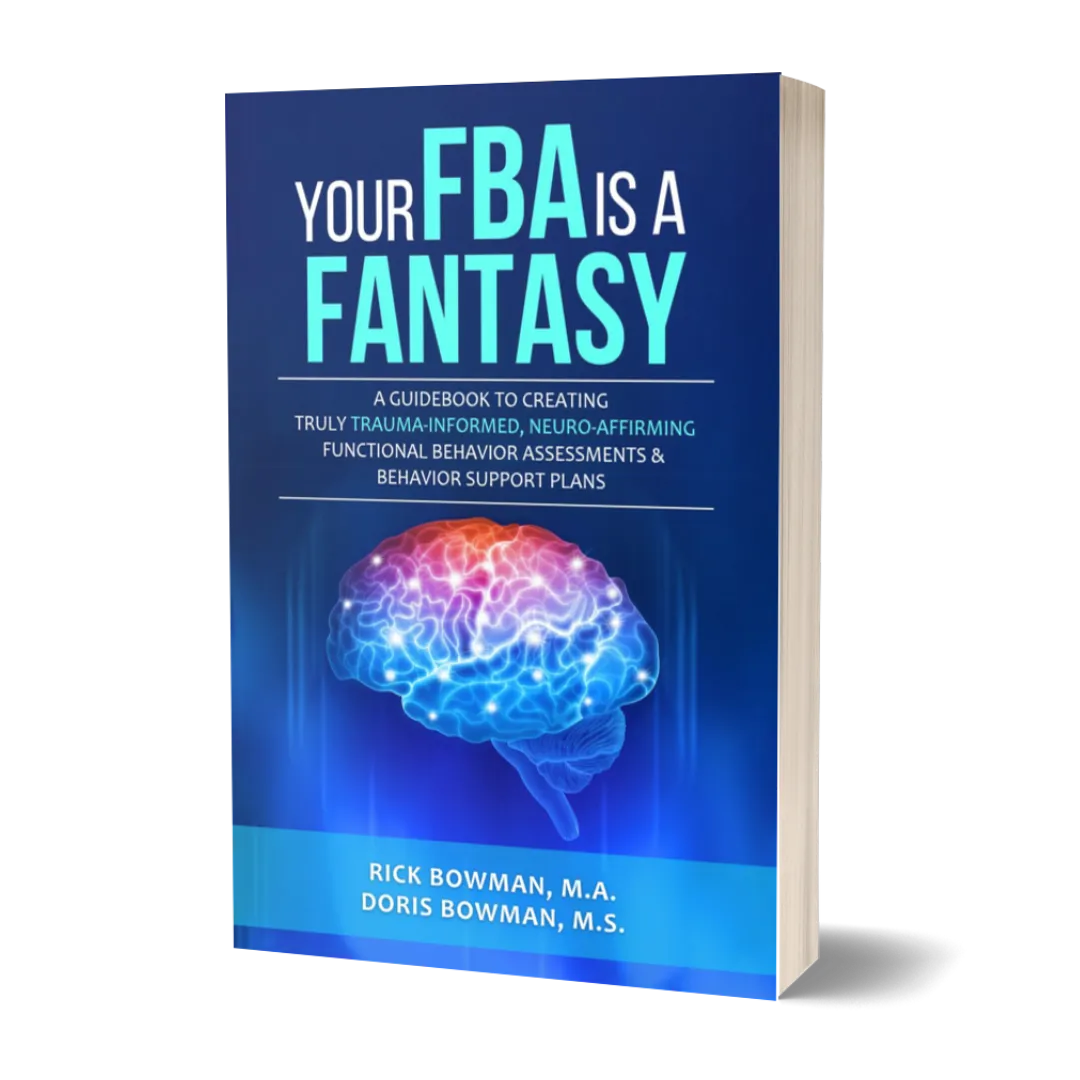
THE BOOK BEHIND THE TRAINING
Everything in this session comes from the book.
Your FBA Is a Fantasy! is the foundational guide for special educators who want to write functional behavior assessments and behavior support plans that are actually aligned with how trauma-impacted and neurodivergent brains and bodies work.
It is also the guide for every advocate and parent tirelessly working to see their student thrive in systems that have largely not yet made the move to operate in alignment with nervous system needs
Every concept, every tool, every question raised in this training is drawn directly from its pages. Attending this webinar is your front-row preview of the framework — and the book is where you'll find everything you need to go deeper.
Meet Your Guides
FOUNDERS, BOWMAN CONSULTING GROUP
Rick & Doris Bowman

Rick Bowman, M.A., Clinical Psychology
K-21 licensed school administrator
Doris Bowman, M.S. in Education/Spec Ed
K-21 licensed special educator & school administrator
Rick & Doris are nationally recognized trainers, authors, and consultants, equipping schools and organizations to implement trauma-informed, neuroscience-aligned behavior support that actually works for today's kids.
For over a decade, they have traveled the nation delivering live and virtual trainings, working side by side with educators, school psychologists, behavior specialists, clinicians, and building & district leaders who are exhausted, yet committed, and ready for something that works.
Team Bowman doesn't just teach strategies, they shift paradigms. By grounding their work in powerful credentials and tools like: Advanced Certified Trauma & Resilience Practitioner - Education & Clinical (ACTRP-E/C®), “Stress & Well-Being Assessment” by HeartMath, Collaborative Problem Solving® (Think:Kids, Massachusetts General Hospital) and 60+ years of modern brain science and the neuroscience of trauma and connection, Rick and Doris arm the adults in the room with the best in trauma-responsive practices and systems to become the most powerful intervention in a child's life.e.
Reserve Your Seat
Thursday, July 30, 2026 / Time: 7:30 - 9:30pm EST / 4:30 - 6:30pm PST
Bring a real plan. Leave with a real tool. And the neuroscience to back up every conversation you have at the IEP table.
STANDARD REGISTRATION
$100
Full access to the live 2h training, the 3T Trouble Spot Identifier tool, and the live Q&A with Rick and Doris.
If you have a cupon code you will be able to add it on checkout page
How to use the discount: If you're part of Karen Mayer Cunningham's Special Education Academy community and attended her behavior webinar with the Bowmans as special guests, you received a referral code. Enter it at checkout to access your discount automatically.
Secure checkout · Instant confirmation · Recording available to registered participants
Bowman Consulting Group
Co-Regulation.
Connection.
Cognition.
Website: www.bowmanconsultgorup.com